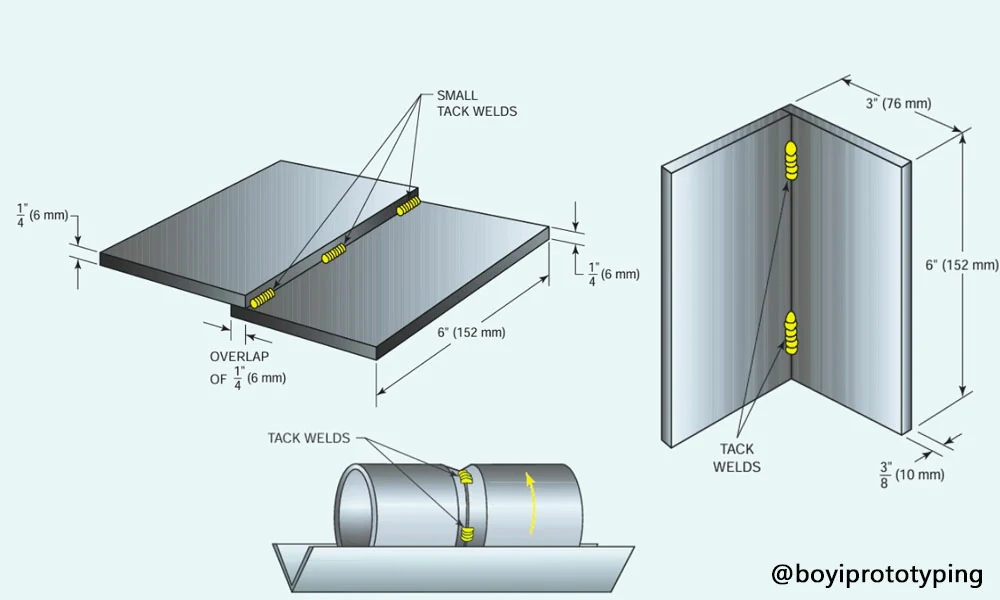
Understanding the types of tack welding is essential for producing strong, accurate, and high-quality welds in both industrial and DIY fabrication projects. Tack welding is the process of making small temporary welds that hold metal components in their correct position before the final weld is completed. Although tack welds are temporary, selecting the right type of tack weld significantly influences alignment, weld penetration, heat distribution, and the overall strength of the finished joint.
Different fabrication projects require differenttypes of tack welding depending on the material, joint design, welding process, and project requirements. Whether using MIG welding, TIG welding, or stick welding, choosing the appropriate tack welding technique helps reduce distortion, improve fit-up, and minimize costly rework. From automotive repair and sheet metal fabrication to structural steel construction and pipeline installation, tack welding remains a critical step that ensures precision throughout the welding process.
Professional welders understand that proper tack welding is more than simply joining two pieces of metal temporarily. It creates a stable foundation that allows the final weld to achieve maximum strength and durability. Learning the various tack welding methods also improves efficiency by reducing movement during welding and maintaining accurate dimensions across the entire assembly.
Common Types of Tack Welding for Better Results
The most widely used types of tack welding vary according to the application and the complexity of the project. Standard tack welds are commonly placed at equal intervals along the joint to keep workpieces securely aligned before continuous welding begins. These evenly spaced tack welds help distribute heat more uniformly, reducing the risk of distortion during the final welding stage.
Bridge tack welding is another technique frequently used when there are small gaps between metal pieces. In this method, the tack weld temporarily bridges the gap while maintaining alignment until the permanent weld fills the joint completely. This approach is especially useful in structural fabrication and pipe welding where maintaining proper joint spacing is essential.
Chain tack welding is commonly used for longer weld joints. Instead of placing isolated tack welds, multiple tack welds are positioned in sequence along the joint to improve stability. This method is particularly effective when working with heavy steel components that require additional support during fabrication.
Opposing tack welding is designed to balance heat distribution by placing tack welds on opposite sides of the joint. Alternating the weld locations helps minimize internal stress and reduces the likelihood of warping, especially when welding stainless steel or aluminum.
Temporary holding tack welds are often used during custom fabrication projects where components may need adjustment before final welding. These small welds allow welders to verify measurements, alignment, and fit before completing the permanent weld. Understanding these types of tack welding enables fabricators to choose the best method for each specific application while maintaining superior weld quality.
Types of Tack Welding Across Different Industries
The importance of learning the types of tack welding becomes clear when examining their use across multiple industries. Structural steel fabrication depends heavily on tack welding to hold beams, columns, and framework securely during assembly. Accurate tack weld placement ensures that large structures remain properly aligned before permanent welds are completed.
In automotive manufacturing, different tack welding methods help assemble vehicle frames, suspension components, body panels, and exhaust systems. Proper tack weld selection improves dimensional accuracy while reducing assembly errors that could affect vehicle safety and performance.
Pipe welding requires highly accurate tack welds because even slight misalignment can lead to poor weld penetration and potential leaks. Professional pipe welders use carefully positioned tack welds to maintain consistent root gaps while ensuring the pipe remains perfectly aligned throughout the welding process.
Sheet metal fabrication also relies on specialized types of tack welding because thin materials are highly sensitive to heat distortion. Small and evenly distributed tack welds help maintain flat surfaces while minimizing thermal expansion during fabrication. This technique is commonly used in HVAC manufacturing, appliance production, metal cabinets, and architectural metalwork.
Heavy equipment manufacturing, agricultural machinery, marine construction, aerospace engineering, and industrial equipment fabrication all benefit from selecting the correct tack welding method. Each application requires a balance between holding strength, heat control, and ease of final welding to achieve long-lasting structural performance.
Advancements in inverter welding technology have also improved tack welding quality. Modern welding machines provide greater arc stability, better heat control, and more consistent weld characteristics, allowing operators to produce cleaner tack welds regardless of the welding process being used.
Types of Tack Welding for Long-Term Welding Performance
Choosing the appropriate types of tack welding involves more than selecting a welding pattern. Material preparation remains one of the most important factors in producing reliable tack welds. Metal surfaces should always be cleaned thoroughly to remove rust, oil, paint, moisture, and oxidation before welding begins. Clean surfaces improve weld penetration and create stronger temporary joints that support the final weld.
Material thickness also determines which tack welding technique is most suitable. Thin sheet metal generally requires smaller tack welds with lower heat input to prevent warping, while thicker steel sections often need larger tack welds to hold heavy components securely during fabrication.
Joint fit-up is equally important. Properly fitted joints reduce internal stress and allow tack welds to perform their intended function without unnecessary strain. Welding clamps, fixtures, and magnetic holders are commonly used to maintain accurate positioning while tack welds are applied.
Inspection should always follow tack welding. Every tack weld should be examined carefully before final welding begins to identify cracks, porosity, incomplete fusion, or weak penetration. Replacing defective tack welds early helps prevent structural failures and improves the quality of the finished weld.
Experienced welders often combine multiple types of tack welding within a single fabrication project to achieve optimal results. By adjusting tack weld placement according to joint configuration, material type, and welding sequence, they maintain alignment while minimizing distortion throughout the entire welding process.
Continuous training and practical experience allow welders to develop greater control over arc length, travel speed, heat input, and weld positioning. These skills improve tack weld consistency and contribute directly to stronger, cleaner, and more professional final welds.
Conclusion
Understanding the various types of tack welding is essential for achieving precise alignment, reducing distortion, and producing strong, durable welds. Every welding project, whether involving structural steel, automotive fabrication, sheet metal, pipelines, or industrial equipment, benefits from selecting the appropriate tack welding method. Proper tack weld placement creates a stable foundation that supports the final weld while improving efficiency and reducing costly fabrication errors.
By focusing on correct material preparation, proper heat control, accurate joint fit-up, and thorough inspection, welders can maximize the effectiveness of different types of tack welding in every application. Mastering these techniques leads to higher-quality fabrication, improved structural integrity, and professional welding results that meet industry standards. As welding technology continues to evolve, a strong understanding of tack welding methods will remain an essential skill for fabricators seeking precision, productivity, and long-term performance.