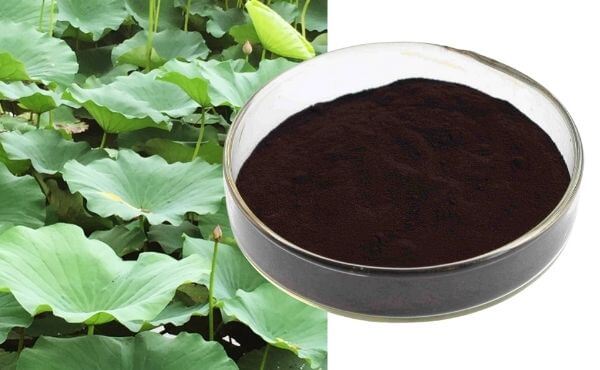
Walking through China's wholesale botanical market, one specification keeps appearing across supplier catalogs: Lotus Leaf Extract standardized to 2% nuciferine by HPLC. Unlike vague ratio claims such as "10:1 extract," this specification offers something real—a measurable marker backed by a validated analytical method. For B2B buyers in the supplement industry, understanding why 2% nuciferine matters can make the difference between a reliable ingredient and an expensive mistake.
What Is Nuciferine?
Lotus leaves (Nelumbo nucifera leaves) have been used in traditional Chinese medicine for centuries, primarily for clearing heat, relieving summer discomfort, and promoting healthy digestion. The key bioactive compound driving much of this activity is nuciferine, an aporphine-type alkaloid found naturally within the leaf tissue. Raw lotus leaves typically contain only small amounts of nuciferine—around 1% or less of total alkaloid content. A 2% nuciferine specification means that after extraction and concentration, at least 20 milligrams per gram of final powder has been enriched to this alkaloid. This level is widely recognized in the wholesale trade as a practical starting point for dietary supplement formulations.
Why HPLC?
The "HPLC" in the specification is the foundation of quality control. High-Performance Liquid Chromatography provides an accurate, reproducible measurement of nuciferine content. The combination of TLC for identification and HPLC for quantification has been established as the quality standard for Lotus Leaf extract. Without HPLC verification, a supplier's claimed nuciferine percentage is merely an approximation.
Pharmacology: Why the Demand?
Recent research reveals that nuciferine possesses a broad range of biological activities. A comprehensive review has documented immunomodulatory and antioxidative effects, neuroprotective properties, cardioprotective benefits, metabolism‑regulating activity, and even antipsychotic and anticancer properties. Notably, its underlying mechanisms involve the modulation of key signaling pathways such as AMPK (AMP‑activated protein kinase) and PPARa (peroxisome proliferator‑activated receptor alpha), which contribute to its metabolic regulation and anticancer properties. It has been found to act as a multi‑target vasodilator, promoting the relaxation of blood vessels via the NO signaling pathway and various ion channels.
Most importantly for weight management—currently the primary application for commercial nuciferine extract—research has shown that nuciferine interacts with serotonin receptors 5‑HT2A and 5‑HT2C, which are involved in appetite regulation and lipid metabolism.
Market Availability in China
China's herbal extract industry has developed a full range of nuciferine specifications. While the 2% grade is the most common entry point for dietary supplements, suppliers also offer 1%, 2%, 5%, 10%, 20%, 50%, and 98% nuciferine by HPLC. Many manufacturers also produce water-soluble versions at 2‑5% nuciferine for beverage applications. Suppliers are concentrated in Xi'an and Shaanxi province, which serve as China's primary hub for botanical extract manufacturing.
Buyer Verification Checklist
When purchasing Lotus Leaf Extract 2% nuciferine HPLC from a China supplier, the following verifications are essential.
Request the full COA. A proper COA must include the nuciferine HPLC assay result, heavy metals (lead, arsenic, cadmium, mercury), microbial counts, loss on drying (typically below 5%), and pesticide residues.
Confirm extraction method. Nuciferine is typically extracted using ethanol‑water mixtures or increasingly advanced techniques such as supercritical CO₂ extraction for purer yields.
Check batch‑to‑batch consistency. Request COAs from three separate production batches. The nuciferine levels should consistently fall within 1.9‑2.1%, with limited variation.
Verify botanical identity. The COA should state Nelumbo nucifera, plant part (leaf), and ideal confirmation of identity via TLC or HPTLC fingerprinting, not just a generic species name.
Third‑party verification for first orders. Many experienced buyers arrange independent lab testing for the first 2‑3 shipments from any new source. Reliable Chinese suppliers will not object to sending samples to a third‑party lab like SGS or Intertek for verification.
Final Thoughts
Sourcing Lotus Leaf Extract from China's wholesale market becomes straightforward when requirements are anchored to a clear specification—2% nuciferine determined by HPLC. The suppliers who willingly provide full COAs with chromatograms, disclose extraction methods, and demonstrate consistent batch records are the ones worth establishing partnerships with. Insist on the data, and the 2% nuciferine benchmark will reliably deliver a consistent ingredient for supplement formulations.